Best Soil for Spider Plants: Mix, Ratio & DIY Recipe
By Sara Linwood, houseplant writerLast updated
The best soil for spider plants is a light, airy mix of 50% potting soil, 30% perlite and 20% orchid bark, which holds enough moisture for fast growth but still dries within 5 to 8 days of watering. Spider plants (Chlorophytum comosum) store water in thick, white tuberous roots, so they forgive a missed watering but rot quickly in dense, soggy soil.
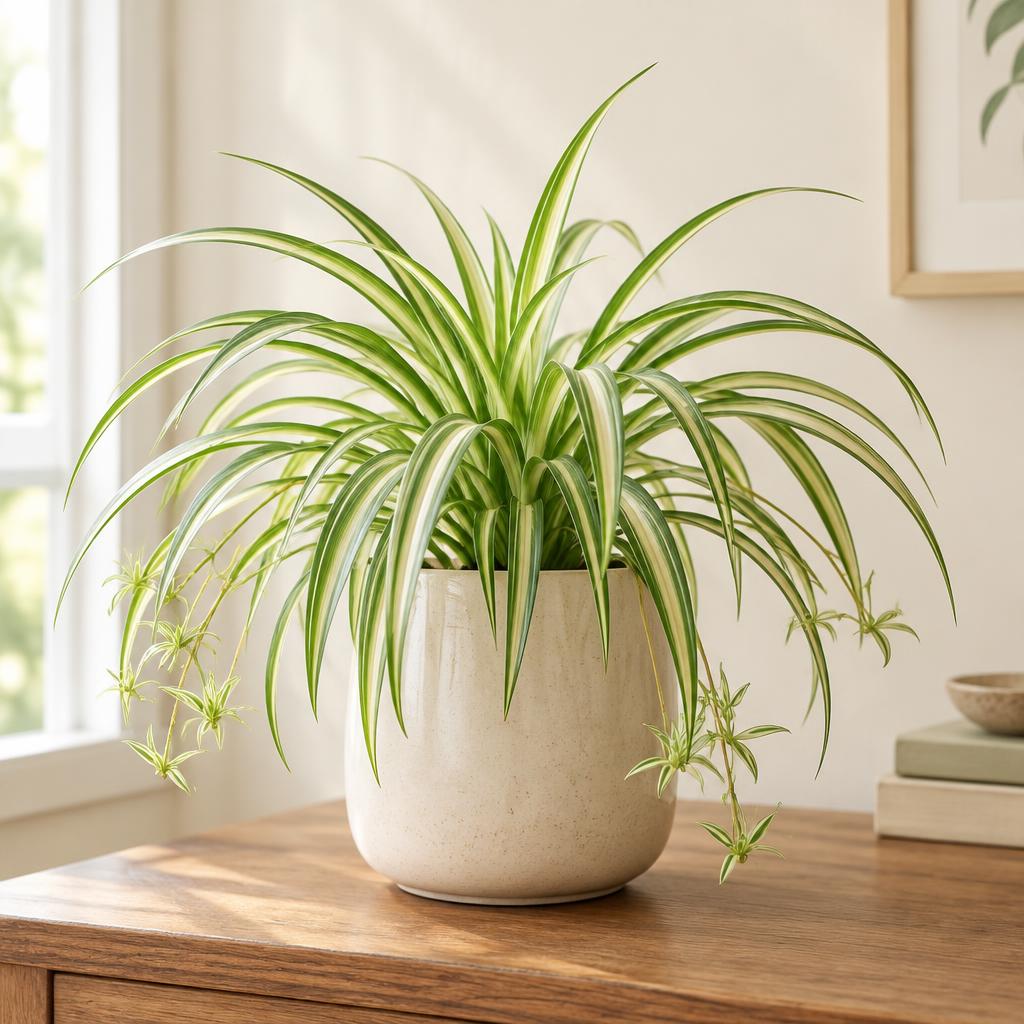
What kind of soil do spider plant roots actually need?
Spider plants grow thick, white, tuberous roots that look a bit like small parsnips. Those roots are water storage organs, which is why a spider plant can sail through a week of neglect while a peace lily collapses. The trade-off is that tuberous roots are built for occasional soaking followed by air, not for sitting in permanently wet soil.
In the wild, Chlorophytum comosum grows in lightly shaded, well-drained ground in South Africa, often in rocky or leaf-littered soil that never stays sodden. Indoors, the closest match is a standard potting mix loosened with mineral and chunky material so water moves through quickly and air reaches the roots between waterings.
If your mix stays wet for more than about 10 days, the tubers start to soften and rot, and the first above-ground sign is usually yellowing lower leaves rather than wilting. Good structure matters more than rich feeding: spider plants are light feeders, and a lean, airy mix beats a heavy, fertile one every time.
What is the best soil mix ratio for a spider plant?
A reliable baseline is 50% potting soil, 30% perlite and 20% orchid bark. The potting soil holds moisture and nutrients, the perlite keeps the mix open and fast-draining, and the bark adds chunky air pockets that the thick roots appreciate. If you are choosing between drainage materials, our guide to perlite vs pumice explains the trade-offs.
| Ingredient | % of mix | Role |
|---|---|---|
| Potting soil | 50% | Holds moisture and nutrients for fast growth |
| Perlite | 30% | Keeps the mix open, speeds drainage, prevents compaction |
| Orchid bark | 20% | Adds chunky air pockets around the tuberous roots |
To check a mix you have already blended, run the ratio through the soil mix calculator and see how its drainage percentage shifts with your home type and pot material before you pot up.
Your spider plant soil, measured
Spider Plant recipe
6 inch (15 cm) plastic pot, normal home
- Potting mix 50%3.5 cups (830 ml)
- Perlite 30%2 cups (474 ml)
- Orchid bark 20%1.5 cups (356 ml)
Total about 7 cups. Light and airy so thick tuberous roots never sit wet, drying in 5 to 8 days.
How do I make my own spider plant soil mix at home?
Step by step
DIY Spider Plant Soil Mix
Time: about 15 minutes
You'll need
- 5 cups (about 1,200 ml) standard potting soil
- 3 cups (about 710 ml) perlite
- 2 cups (about 475 ml) orchid bark, medium grade
- Large mixing tub or bucket
- Trowel or scoop
- Spray bottle with water
- Measure the dry ingredients. Scoop 5 cups of potting soil, 3 cups of perlite and 2 cups of orchid bark into a large tub. Measuring by cup keeps the ratio consistent from batch to batch.
- Mix thoroughly. Combine with a trowel or your hands until the texture looks even, with no pockets of pure perlite or pure soil.
- Moisten lightly. Mist with a spray bottle until the mix is faintly damp, not wet. This stops dry pockets and helps it settle around the roots.
- Check drainage. Fill a pot with drainage holes and pour a cup (240 ml) of water through; it should run out of the bottom within 15 to 20 seconds.
- Pot the plant. Settle the roots into the mix, firm gently, and water lightly to settle everything in place.
Can I use a store-bought potting mix instead?
Yes. Most general houseplant potting mixes work for spider plants with one tweak: stir in about 25% extra perlite by volume. Bagged mixes are usually peat or coir heavy and compact over time, and that extra perlite keeps the structure open for the two years between repottings.
| Product type | Drainage speed | Needs amending? |
|---|---|---|
| Standard potting soil | Slow, stays wet 10 to 14 days | Yes, add 25 to 30% perlite |
| Houseplant mix with perlite | Medium, dries in 7 to 10 days | Optional, add 10 to 15% bark |
| Cactus or succulent mix | Fast, dries in 3 to 5 days | Yes, add 20 to 30% coir or soil so it does not dry too fast |
Avoid mixes labelled moisture control or water retaining. They are designed for thirsty outdoor containers and hold water far too long for tuberous roots.
What pH does spider plant soil need, and why do the tips go brown?
Spider plants prefer a slightly acidic to neutral pH of 6.0 to 7.0, which almost every commercial potting mix already provides. You rarely need to adjust pH unless you are mixing in garden soil.
Brown leaf tips are the classic spider plant complaint, and soil plays a bigger role than most people expect. Spider plants are sensitive to fluoride and boron, which build up in the soil when you water with tap water, and to fertilizer salts that accumulate in a mix that is never flushed. The result is scorched tips even when your watering rhythm is perfect.
- Water with rainwater, distilled water or filtered water if your tap water is heavily treated.
- Flush the soil every 2 to 3 months: water slowly until it runs freely from the drainage hole for a minute, washing salts out.
- Feed at half strength at most, once a month in spring and summer, and skip feeding entirely in winter.
- Repot into fresh mix every 1 to 2 years so old, salt-loaded soil does not linger.
How do I know my soil mix is wrong for my spider plant?
Watch the plant and the pot rather than the calendar. If you also notice roots circling the surface or pushing the plant upward, check the signs your plant needs repotting before assuming the mix itself is at fault.
| Sign | Likely cause | Fix |
|---|---|---|
| Yellowing lower leaves, soft tubers | Mix stays wet too long, roots rotting | Unpot, trim mushy roots, repot in a faster mix |
| Soil wet past 10 days | Too much peat or coir, not enough perlite | Amend with 20 to 25% more perlite |
| Soil dry within 2 to 3 days | Mix too gritty or plant severely root-bound | Add 15% more potting soil, or repot one size up |
| Brown, crispy leaf tips | Fluoride or salt buildup in the soil | Flush the soil, switch to filtered or rain water |
| Water runs straight through | Mix has gone hydrophobic or compacted | See how to fix compacted soil |
When and how should I repot a spider plant into fresh soil?
Repot every 1 to 2 years, ideally in spring. Spider plants actually enjoy being slightly pot-bound and often produce more plantlets (spiderettes) when snug, but their roots are strong enough to distort or crack a plastic pot, so do not wait that long.
- Water the plant a day before repotting so the roots are flexible.
- Slide the plant out and tease apart the outer roots; expect a dense, fleshy root ball.
- Trim any soft, brown or hollow tubers with clean scissors.
- Choose a pot only 1 to 2 inches (2.5 to 5 cm) wider, with a drainage hole.
- Fill with fresh 50/30/20 mix, firm gently, and water lightly to settle.
If you are mixing for several plants at once, the same drainage-first logic applies across the shelf; see our guides for pothos and peace lily for comparison.
Advice by situation
Beginners
Buy a standard houseplant potting mix and stir in 25% extra perlite. It is a two-ingredient job, very forgiving, and gets you 90% of the way to the ideal mix.
Dry homes
Lean toward 55% potting soil and 25% perlite, since dry air pulls moisture from the pot faster. A plastic or glazed ceramic pot also slows evaporation compared with terracotta.
Humid homes
Push the perlite up to 35% and keep the bark at 20%, because humid air slows surface drying and the mix stays wet longer than the same ratio would in a dry home.
Over-waterers
Use the full 50/30/20 ratio in a terracotta pot, which wicks excess moisture out through its walls. Check the soil 2 inches (5 cm) down before every watering and only water when it is dry.
Common mistakes to avoid
- Using a moisture control potting mix. Choose a standard mix and add 25% perlite; water-retaining mixes keep tuberous roots wet for too long.
- Watering with untreated tap water for years. Switch to rainwater or filtered water, and flush the soil every few months to clear fluoride and salts.
- Repotting into a much bigger pot. Size up by only 1 to 2 inches (2.5 to 5 cm); spider plants like being slightly snug and oversized pots stay wet.
- Feeding at full strength. Feed at half strength once a month in spring and summer only, since salts build up fast and scorch the leaf tips.
- Letting the mix compact for years. Repot every 1 to 2 years into fresh mix; old peat-based soil collapses and suffocates the roots.
- Using a pot without a drainage hole. Always use a pot with a hole, and empty the saucer 15 minutes after watering.
Quick checklist
- Mix 50% potting soil, 30% perlite, 20% orchid bark.
- Confirm pH between 6.0 and 7.0.
- Use a pot with a drainage hole.
- Test drainage: a cup (240 ml) of water should run through within 20 seconds.
- Water when the top 2 in / 5 cm of soil is dry, ideally with rain or filtered water.
- Flush the soil every 2 to 3 months to clear salt buildup.
- Repot every 1 to 2 years, one pot size up, in spring.
Frequently asked questions
Can I use regular potting soil alone for a spider plant?
It will survive, but the mix compacts within a year and holds water too long for the tuberous roots. Stir in 25% perlite and the same bag becomes a good spider plant soil.
Why are my spider plant's leaf tips brown even though I water correctly?
The usual culprit is fluoride or fertilizer salts building up in the soil, not underwatering. Flush the soil thoroughly, switch to filtered or rainwater, and cut feeding to half strength.
How often should I water a spider plant in this mix?
Expect every 7 to 10 days in bright indirect light, less in winter. Always check that the top 2 inches (5 cm) are dry first rather than watering on a fixed schedule.
Do spider plants like to be root-bound?
Yes, slightly. A snug pot encourages more plantlets. Repot only when roots circle densely, push the plant upward, or start cracking the pot, usually every 1 to 2 years.
Is cactus soil good for spider plants?
It is too fast-draining on its own and will dry out within a couple of days. Blend it with 20 to 30% potting soil or coco coir to slow it down to the 5 to 8 day drying window spider plants prefer.