Fiddle Leaf Fig Root Rot: Signs, Fixes and the Soil That Stops It
By Sara Linwood, houseplant writerLast updated
If your fiddle leaf fig drops lower leaves with dark brown spots that start in the middle or at the base of the leaf, and the soil stays wet, suspect root rot. Trim the mushy roots and repot into a well-draining mix of 60% potting mix, 20% orchid bark and 20% perlite, in a pot only slightly larger than the roots.
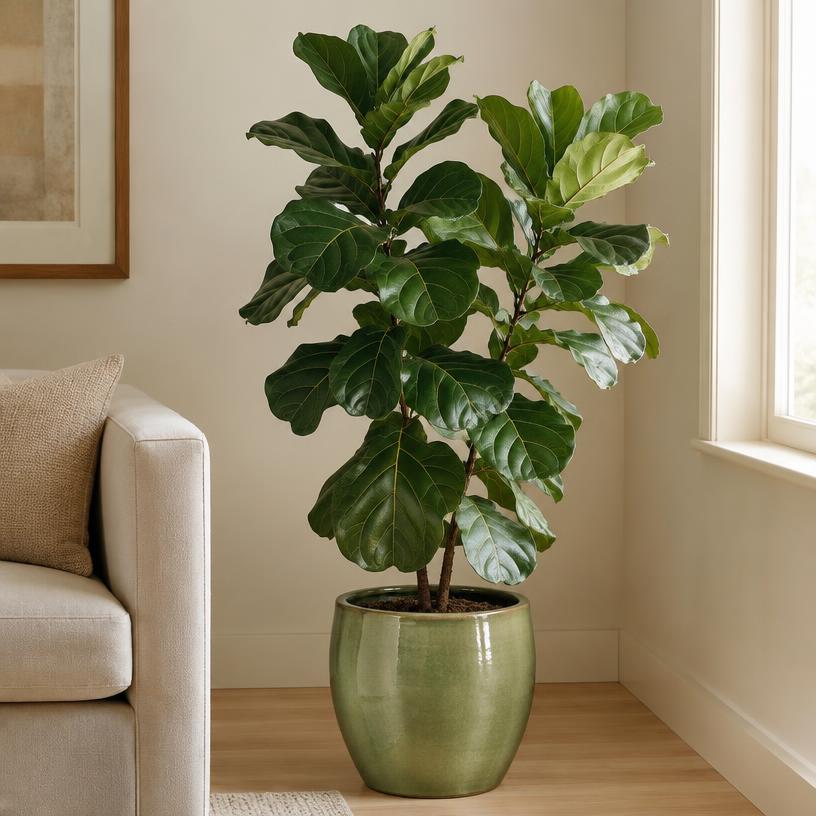
What does root rot look like on a fiddle leaf fig?
The clearest sign is dark brown spots on the lower leaves, often starting in the middle of the leaf or near the leaf base rather than at the edge, followed by those leaves dropping. Fiddle leaf figs hold their lower leaves for years when healthy, so losing several from the bottom up is a red flag.
The spots tend to be dark and soft, sometimes with a yellow edge. The plant may also stop growing, and new leaves can come in small. The soil stays damp for longer than a week and may smell musty.
- Dark brown spots in the middle or base of lower leaves.
- Lower leaves dropping, from the bottom up.
- Yellowing around the brown spots.
- Soil wet for 10 days or more after watering.
- Stalled growth in spring and summer.
Note that fiddle leaf figs also drop leaves after being moved or exposed to cold drafts. If leaves fall with no brown spots right after a move, give it a few weeks before assuming rot.
Why does a fiddle leaf fig get root rot?
Fiddle leaf figs rot when soil stays wet beyond about 7 to 10 days. They need more organic matter than a succulent, but their roots still need air. A pot full of dense, wet soil under a tall, slow-drinking tree is the classic setup for rot.
- Heavy, peat-only soil. The best soil for fiddle leaf figs adds bark and perlite.
- A heavy decorative pot without a hole. Common with large indoor trees.
- An oversized pot chosen to balance a tall plant visually.
- Lower light. These plants need bright light to use water. In a dim spot they drink very little.
- Winter watering at summer volumes.
- Old, compacted soil in a plant that has been top-dressed for years.
| Spot type | Likely cause | Soil state |
|---|---|---|
| Dark, soft, mid-leaf | Root rot or overwatering | Wet |
| Light brown, crispy edges | Underwatering or dry air | Dry |
| Small red-brown dots on new leaves | Uneven moisture, edema | Swings wet to dry |
| Leaf drop, no spots | Move, draft or cold | Any |
How do you check fiddle leaf fig roots?
Lay the pot on its side, support the trunk, and slide the root ball out. Big trees need two people. If the pot is too heavy, dig down at the edge with a trowel to inspect roots near the bottom.
Healthy roots are light tan to brown, firm, and smell earthy. Rotten roots are dark brown to black, soft and slimy, and the outer layer slides off. Rot usually starts at the bottom and center of the root ball where water lingers longest.
| Feature | Healthy | Rotten |
|---|---|---|
| Color | Light tan to brown | Dark brown to black |
| Texture | Firm, woody | Mushy, slimy |
| Smell | Earthy | Sour or rotten |
How do you save a fiddle leaf fig with root rot?
Trim the rot, then repot into a pot fitted to the remaining roots with fresh, structured mix. Most fiddle leaf figs recover if the rot is caught before it reaches the trunk.
Step by step
How to treat fiddle leaf fig root rot
Time: about 75 minutes
You'll need
- Clean, sharp pruners
- Rubbing alcohol
- Potting mix, 19 1/4 cup (4562 ml) for a 10 inch pot
- Orchid bark, 6 1/2 cup (1540 ml)
- Perlite, 6 1/2 cup (1540 ml)
- Pot with drainage holes
- Gloves (the sap can irritate skin)
- Unpot and loosen soil. Remove the plant and gently tease or rinse old soil away from the roots.
- Cut the rot. Sterilize your pruners and wear gloves. Cut off every dark, soft root back to firm tissue. Remove leaves that are mostly brown.
- Consider cuttings. If almost all roots are gone or the trunk is soft at the base, take 12 inch (30 cm) stem cuttings with 2 to 3 leaves from healthy upper growth and root them in water.
- Repot in structured mix. Mix 60% potting mix, 20% orchid bark and 20% perlite. Use a clean pot about 1 to 2 inches (2.5 to 5 cm) wider than the root ball, with holes.
- Water after a few days. Wait 3 to 5 days, then water slowly until it drains. Then water only when the top 2 inches (5 cm) are dry.
- Keep conditions steady. Put it back in the same bright spot. Do not move it, fertilize it or prune more while it recovers.
Use the soil mix calculator for exact amounts. See how to repot a fiddle leaf fig for handling a tall tree safely.
What other soil problems do fiddle leaf figs get?
Fiddle leaf figs stay in big pots for years, so salt buildup and compaction are common. Most can be fixed with flushing or top-dressing.
| Problem | Cause | Fix |
|---|---|---|
| White mold on soil | Damp surface, low light | Scrape off, water less |
| Fungus gnats | Top layer stays wet | Dry top 2 inches, traps |
| Water runs down the sides | Compacted, shrunken root ball | Aerate, bottom-water, repot |
| White crust | Fertilizer and tap water salts | Flush every few months |
| Sour smell | Waterlogged soil | Check roots promptly |
How do you stop root rot coming back?
Bright light and a pot fitted to the roots stop most fiddle leaf fig rot before it starts.
- Place it within a few feet of a bright window. A fiddle leaf fig in strong light uses water fast, so the mix dries in 7 to 10 days as it should.
- Water deeply, then wait. Pour until water runs from the holes, empty the saucer, and do not water again until the top 2 inches (5 cm) are dry.
- Cut back in winter. Shorter days mean slower growth, so checks every 10 to 14 days are often enough.
- Top-dress or repot on time. Every 1 to 2 years while young, refresh the mix. On big trees, replace the top 2 inches (5 cm) with fresh mix each spring.
Large decorative planters are fine as long as the fig sits in an inner nursery pot with holes, raised on a few stones so it never stands in the water that collects below.
Advice by situation
Beginners
Keep it in the brightest window you have and water only when the top 2 inches are dry. Bright light is the best rot prevention for this plant.
Dry homes
The mix may dry in 7 days. Water thoroughly when it does, then let excess drain.
Humid homes
Allow 10 days or more. Add a little extra perlite when you repot.
Over-waterers
Use a moisture meter or chopstick and water by the reading, never by the calendar.
Common mistakes to avoid
- Moving the plant while it recovers. Keep it in one bright spot. Moves cause more leaf drop.
- Choosing a giant pot to match its height. Size the pot to the roots and use a heavy pot for stability.
- Reusing old soil. Use fresh 60/20/20 mix.
- Watering in small sips often. Water deeply and less often.
- Fertilizing a sick plant. Wait for new leaves first.
Quick checklist
- Look for dark mid-leaf spots and lower leaf drop
- Check that the soil is staying wet
- Unpot and trim dark, soft roots
- Repot in fresh 60/20/20 mix
- Use a pot with holes, just 1 to 2 inches wider
- Wait 3 to 5 days before watering
- Keep it in the same bright spot
Frequently asked questions
Can a fiddle leaf fig recover from root rot?
Yes, if healthy roots remain. Expect some leaf drop for a few weeks. New leaves at the top are the sign it is recovering.
Should I use hydrogen peroxide on fiddle leaf fig roots?
It is optional. A rinse of 3% household peroxide diluted with 2 parts water is commonly used, but trimming and well-draining soil are what fix the problem.
Does root rot spread to other plants?
It can spread through shared soil, trays and tools. Use fresh mix and clean the pot and pruners.
Will brown spots on fiddle leaf fig leaves go away?
No. Damaged areas stay brown. Remove badly spotted leaves once the plant is putting out new ones.
How often should I water a fiddle leaf fig after root rot?
Water when the top 2 inches (5 cm) are dry, usually every 7 to 10 days in bright light.
Can I propagate a fiddle leaf fig from a rotting plant?
Yes. Take healthy stem cuttings from the top and root them in water. Roots usually form in 3 to 6 weeks.